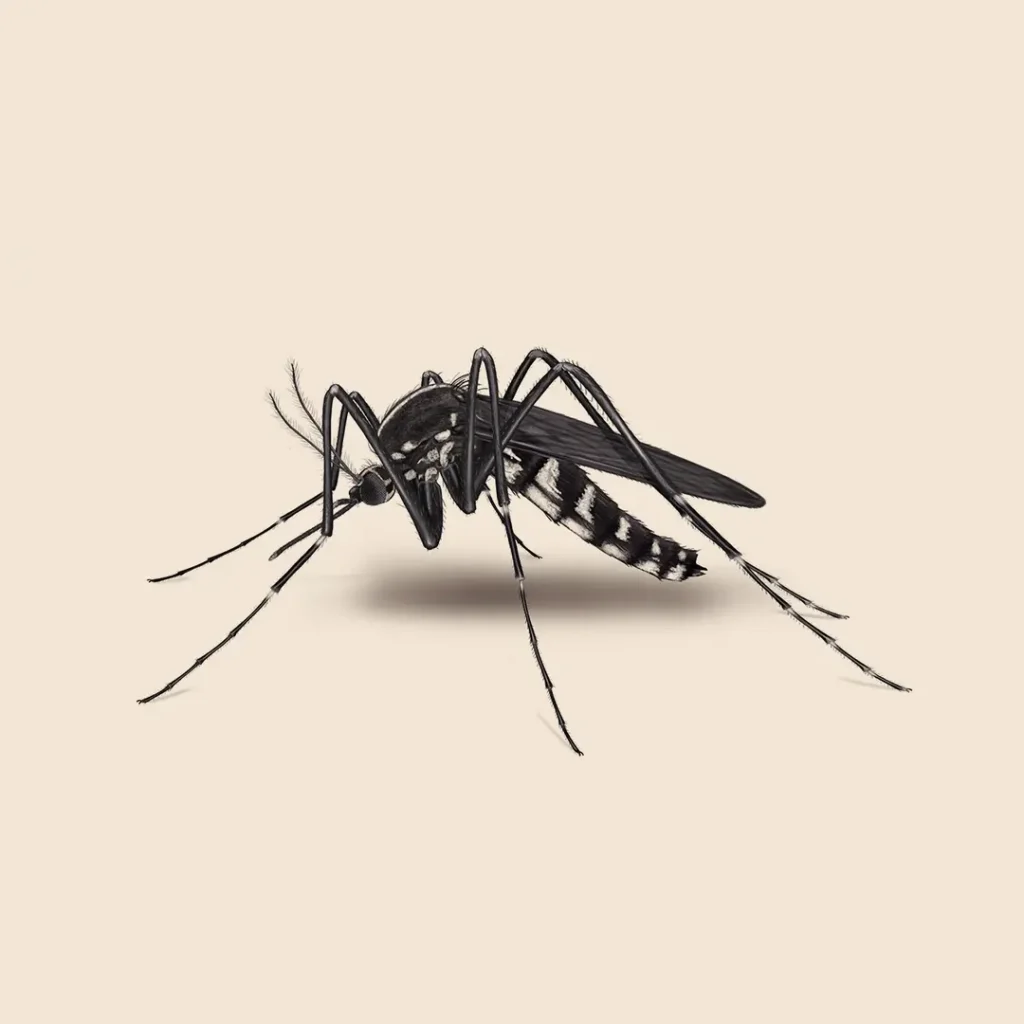
Striped legs and a white stripe that crosses its body.
Get rid of the asian tiger mosquito
At Fumimax, we take care of eliminating the asian tiger mosquito and establish measures to prevent new outbreaks of this and other potential pests in your spaces.
Eradicating the asian tiger mosquito in your spaces is not a one-time action; it is a continuous process. Through our Inspection, Fumigation, and Monitoring process, we ensure your spaces remain pest-free.
Fumimax can help you keep the asian tiger mosquito and other harmful species far away from you and your spaces.
Understanding the asian tiger mosquito
Appearance
- Size: Adults are small insects that vary between 2 and 10 millimeters in length, depending on the nutritional conditions of their breeding site.
- Color: Shiny black.
- Thorax pattern: They feature a single, straight white stripe crossing the center of their head and back.
- Leg bands: Their dark limbs have distinct white rings, giving them the striped appearance that gives them their name.
Behavior and Feeding
- Flight: They operate mainly close to the ground. They are stealthy fliers that direct their attacks almost exclusively toward the ankles and legs.
- Outdoor habitat: They settle in areas with dense vegetation, bushes, and shaded areas. They have high climate resilience, allowing them to colonize urban, suburban, and rural spaces with ease.
- Entering homes: They access facilities by following human carbon dioxide currents. They exploit fissures, open doors, or torn window screens.
- Diet: Both sexes consume plant nectar to maintain their energy levels. Females require blood protein for their eggs to mature. They are extremely aggressive daytime biters, with activity peaks at dawn and before dusk.
Reproduction and Development
- Breeding sites: They use any small volume of stagnant water. They deposit their eggs in outdoor tires, flowerpot saucers, clogged gutters, and natural tree cavities.
- Resilience: Females adhere the eggs to the dry walls of containers. This species has the ability to survive months of absolute drought; their eggs hatch almost immediately upon contact with rainwater.
- Growth: The full aquatic cycle (from larva to pupa) develops in just 7 to 14 days. High temperatures drastically accelerate this process.
Additional Information
- Origin and spread: Native to Southeast Asia, they are classified as one of the most successful invasive species globally. Their international spread occurred mainly through the maritime trade of used tires.
- Particularities: Unlike other variants that flee after a failed biting attempt, the Asian tiger is highly territorial and persistent, repeatedly attacking the same host until achieving its goal.
YOUR PEACE OF MIND AND
YOUR SPACES' HYGIENE IS
GUARANTEED WITH
FUMIMAX®
Schedule a visit from one of our technicians in the Bajio region and let our team of professionals deal with your pest problems.
PREVENTIVE HEALTH:
LEARN HOW TO AVOID
PESTS
IN THE FIRST PLACE
The best way to fight pests is to keep them from getting in. We teach you simple habits to care for the hygiene of your factory, business, or home.